Introduction
Alibaba’s Qwen team has released Qwen3, a groundbreaking family of open-source large language models that represents a significant milestone in the open-weight AI landscape. Released on April 29, 2025, the Qwen3 suite includes multiple model sizes ranging from tiny 0.6B parameter models to massive 235B parameter Mixture-of-Experts (MoE) architectures, all under the permissive Apache 2.0 license.
This comprehensive analysis explores Qwen3 and its variants, including the recently released Qwen3.5 and Qwen3-Next models, comparing them against other leading models released in 2025-2026 such as DeepSeek-R1, Llama 4, Claude Opus 4, and Gemini 2.5 Pro.
Qwen3 Model Family Overview
The Qwen3 family consists of two main categories of models:
MoE (Mixture-of-Experts) Models:
- Qwen3-235B-A22B — Flagship model with 235B total parameters and 22B activated parameters per token
- Qwen3-30B-A3B — Smaller MoE model with 30B total parameters and 3B activated parameters
Dense Models:
- Qwen3-32B, Qwen3-14B, Qwen3-8B, Qwen3-4B, Qwen3-1.7B, and Qwen3-0.6B
All models are available under the Apache 2.0 license, making them commercially friendly with no usage restrictions beyond standard open-source terms.
Key Features of Qwen3
1. Hybrid Thinking Modes
One of Qwen3’s most innovative features is its hybrid thinking mode, which allows seamless switching between:
- Thinking Mode — Step-by-step reasoning for complex problems (math, coding, logical reasoning)
- Non-Thinking Mode — Quick, efficient responses for simpler tasks
This flexibility enables users to control the reasoning budget based on task complexity, achieving an optimal balance between cost efficiency and inference quality.
2. Multilingual Support
Qwen3 supports 119 languages and dialects, covering major language families including Indo-European, Sino-Tibetan, Afro-Asiatic, Austronesian, Dravidian, Turkic, Tai-Kadai, Uralic, and Austroasiatic languages.
3. Improved Density and Efficiency
The Qwen3 architecture achieves approximately 50% density improvements over previous generations:
- Qwen3-1.7B performs as well as Qwen2.5-3B
- Qwen3-4B rivals Qwen2.5-7B
- Qwen3-8B matches Qwen2.5-14B
- Qwen3-14B equals Qwen2.5-32B
- Qwen3-32B performs on par with Qwen2.5-72B
4. Pre-training Scale
Qwen3 was pre-trained on approximately 36 trillion tokens, nearly double the 18 trillion tokens used for Qwen2.5. The training process involved three stages:
- S1 — 30+ trillion tokens at 4K context length for basic language skills
- S2 — 5 trillion additional tokens with knowledge-intensive data (STEM, coding, reasoning)
- S3 — High-quality long-context data to extend context to 32K tokens
5. Post-Training Pipeline
The four-stage post-training pipeline includes:
- Long chain-of-thought (CoT) cold start
- Reasoning-based reinforcement learning (RL)
- Thinking mode fusion
- General RL across 20+ tasks
Qwen3.5: The Latest Medium-Sized Variants
Following the initial Qwen3 release, Alibaba introduced Qwen3.5 models, including:
- Qwen3.5-35B-A3B — Medium MoE model optimized for 24GB RAM deployment
- Qwen3.5-27B — Dense model variant
These models represent further improvements in efficiency and performance, making Qwen3.5 particularly attractive for resource-constrained deployments while maintaining competitive benchmark scores.
Qwen3-Next: Revolutionary Hybrid MoE Architecture
Released in September 2025, Qwen3-Next introduces a novel hybrid MoE architecture:
- Qwen3-Next-80B-A3B-Thinking — 80B total parameters with only 3B activated
- Qwen3-Next-80B-A3B-Instruct — Instruct-tuned variant
Key architectural innovations include:
- 512 routed experts with 10 experts activated per token
- Gated Delta Networks from NVIDIA research for efficient long-sequence processing
- Hybrid attention layers — every 4th layer uses GQA attention while remaining layers use linear attention
- 260K+ token context length support
NVIDIA has optimized deployment for Blackwell and Hopper architectures, with support through NIM, SGLang, and vLLM.
Qwen3-Max: The 1T Parameter Frontier Model
On September 5, 2025, Qwen released Qwen3-Max, a closed-source 1 trillion parameter model that reportedly beats Kimi K2, DeepSeek 3.1, and Claude Opus 4 on all major benchmarks. While not open-weight, this model represents the cutting edge of Alibaba’s research capabilities.
Benchmark Comparisons
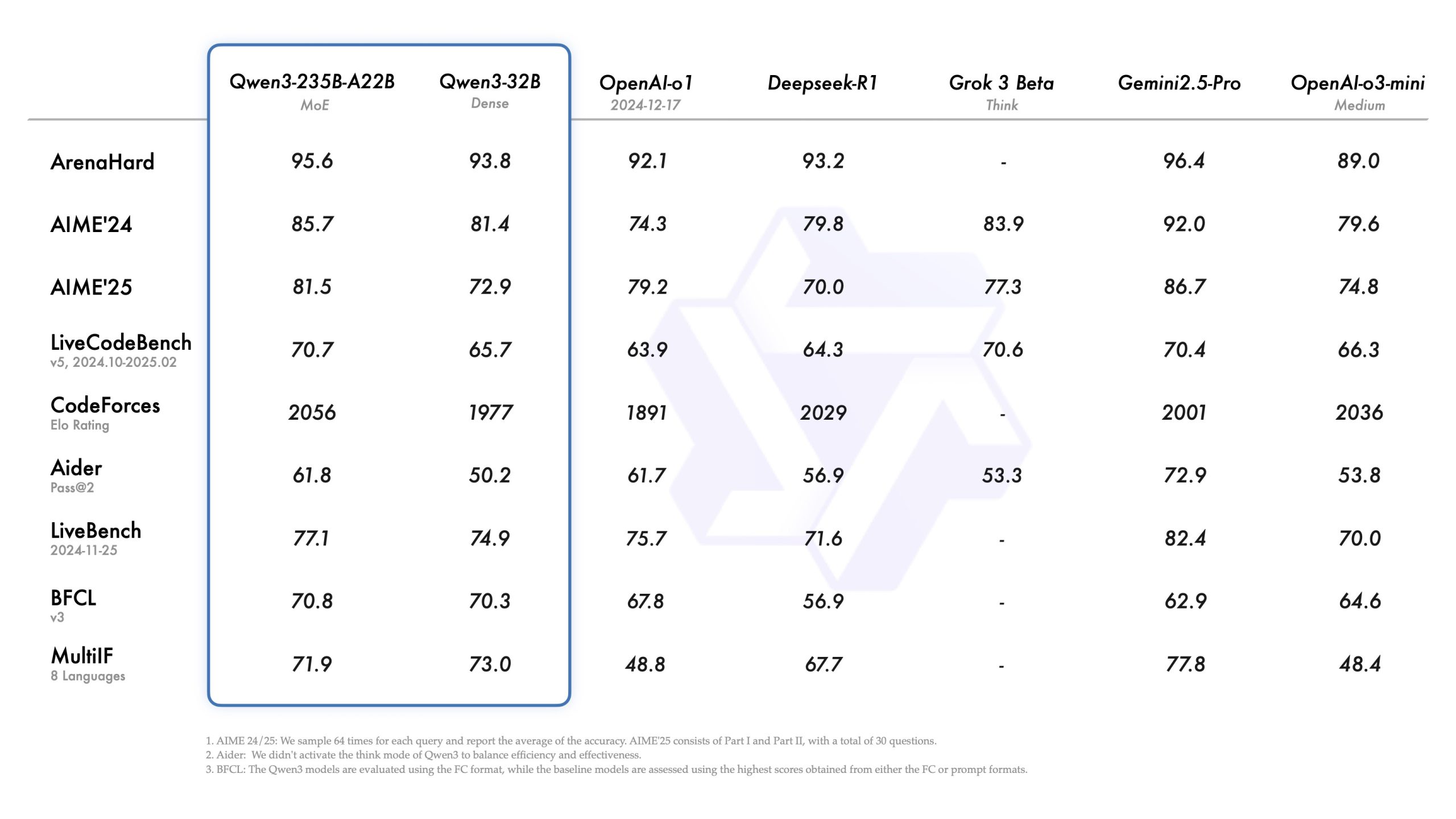
Qwen3-235B-A22B achieves competitive results against other top-tier models including:
- DeepSeek-R1 — Competitor in coding, math, and general capabilities
- o1 / o3-mini — OpenAI’s reasoning models
- Grok-3 — xAI’s model
- Gemini 2.5 Pro — Google’s multimodal model
- QwQ-32B — Outperformed by Qwen3-30B-A3B with 10x more activated parameters
On the LMArena leaderboard, Qwen3-235B-Instruct ranks #8, tied with proprietary Claude Opus 4. The only open-weight models ranking higher are DeepSeek 3.1 (3x larger) and Kimi K2 (4x larger).
Comparison with Other 2025-2026 Models
| Model | Type | Parameters | License | Key Strength |
|---|---|---|---|---|
| Qwen3-235B-A22B | MoE | 235B (22B active) | Apache 2.0 | Best open-source reasoning |
| Qwen3.5-35B-A3B | MoE | 35B (3B active) | Apache 2.0 | Efficient medium model |
| Qwen3-Next-80B-A3B | Hybrid MoE | 80B (3B active) | Apache 2.0 | Long context, efficiency |
| DeepSeek-R1 | Dense | 671B | Apache 2.0 | Reasoning pioneer |
| Llama 4 | Mixed | 109B+ (smallest) | Various | Meta’s latest suite |
| Claude Opus 4 | Closed | Unknown | Proprietary | Best proprietary model |
| Gemini 2.5 Pro | Closed | Unknown | Proprietary | Google’s multimodal leader |
Deployment and Ecosystem
Qwen3 models are widely supported across major frameworks:
- Hugging Face Transformers — Native support with thinking mode
- vLLM — Production deployment with OpenAI-compatible API
- SGLang — Optimized serving with reasoning parser
- Ollama — Local development and deployment
- LM Studio — User-friendly local interface
- llama.cpp — C/C++ based inference
- KTransformers — Kubernetes-native deployment
- NVIDIA NIM — Enterprise containerized deployment
Community Reception
The Qwen3 release generated significant excitement in the open-source AI community:
- Nathan Lambert (Interconnects AI) praised it as “the best of both worlds for open models — peak performance and size scales”
- Sebastian Raschka highlighted Qwen3’s popularity as “one of the most widely liked and used open-weight model families”
- The community noted Qwen3’s reasoning chains start with “Okay,” similar to DeepSeek R1, suggesting R1 was used in training
- Qwen3 effectively “dethroned Llama” as the default model on r/LocalLLaMA
Conclusion
Qwen3 represents a major achievement in open-source AI, offering:
- Competitive performance against proprietary models
- Unmatched size diversity (0.6B to 235B+ parameters)
- Permissive Apache 2.0 licensing
- Innovative hybrid thinking modes
- Massive multilingual support (119 languages)
- Strong community adoption and ecosystem support
With the addition of Qwen3.5 and Qwen3-Next, Alibaba continues to push the boundaries of open-source model efficiency and performance, making these models accessible to researchers, developers, and enterprises worldwide.
Official Resources
- Official Blog Post: Qwen3: Think Deeper, Act Faster
- Qwen Website: qwen.ai
- Hugging Face: Qwen Organization Page
- ModelScope: ModelScope Platform
- Kaggle: Qwen Models on Kaggle
- Qwen Chat: Try Qwen3 Online
- GitHub: QwenLM GitHub Repository
- Discord: Qwen Discord Community
Analysis and Reviews
- Nathan Lambert (Interconnects AI): “Qwen 3: The new open standard” — Comprehensive technical analysis
- Sebastian Raschka: “Understanding and Implementing Qwen3 From Scratch” — Detailed implementation guide
- NVIDIA Technical Blog: “New Open Source Qwen3-Next Models Preview” — Architecture and deployment analysis
Reddit Discussions
The Qwen3 release generated extensive discussion in the AI community:
- r/LocalLLaMA – Qwen3 Discussions — Community reactions and benchmarks
- r/MachineLearning – Qwen3 Technical Discussions — Research and implementation threads
- r/artificial – Qwen3 General Discussions — Broader AI community reactions
Note: Reddit discussions are highly active and frequently updated. The links above will show the most recent Qwen3-related posts in each subreddit.
Images
Figure 1: Qwen3 Model Architecture Overview
The Qwen3 architecture diagram showing the relationship between dense and MoE model variants:
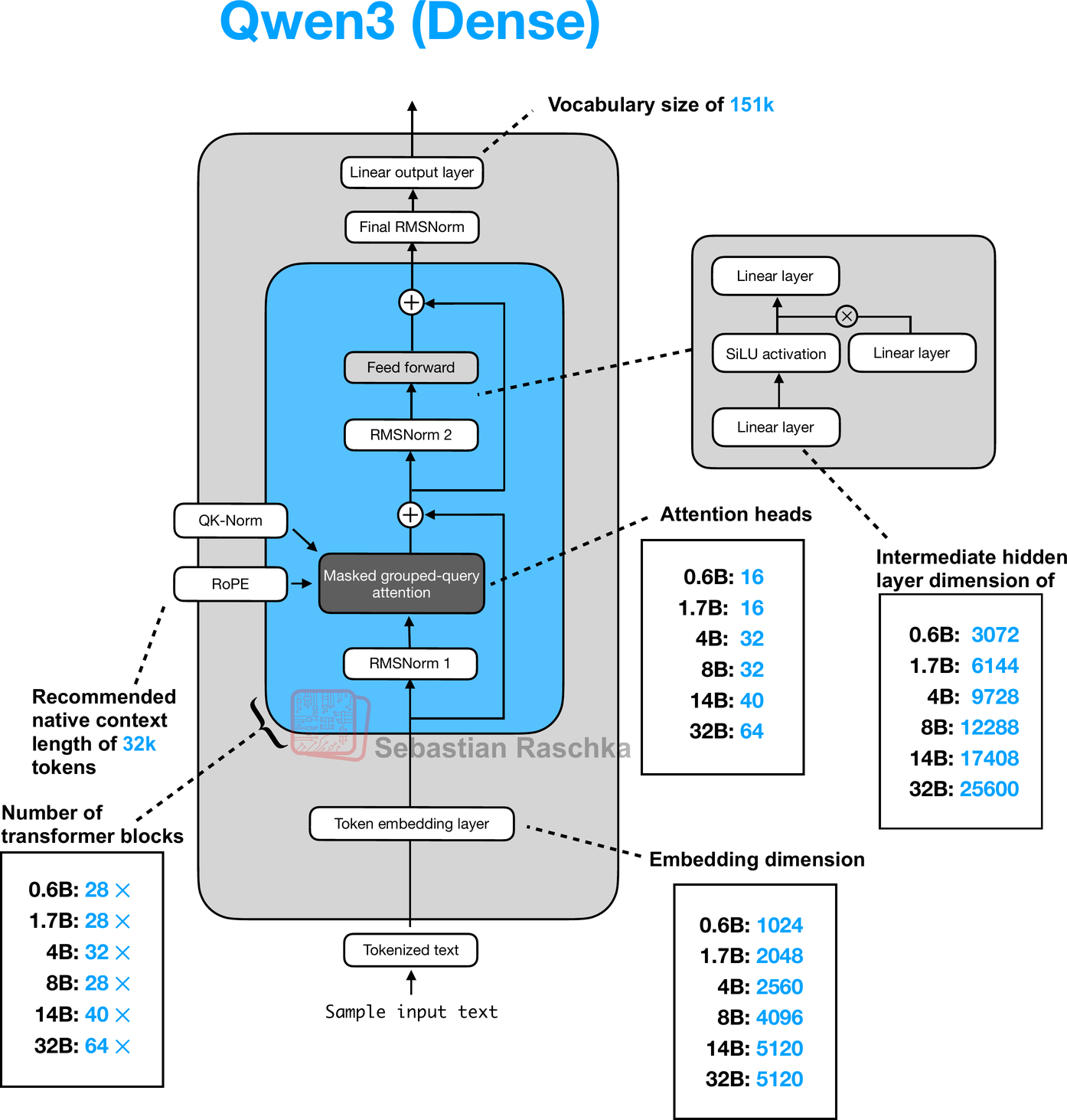
Figure 2: Qwen3-Next Hybrid MoE Architecture
The innovative hybrid MoE architecture of Qwen3-Next with 512 routed experts:
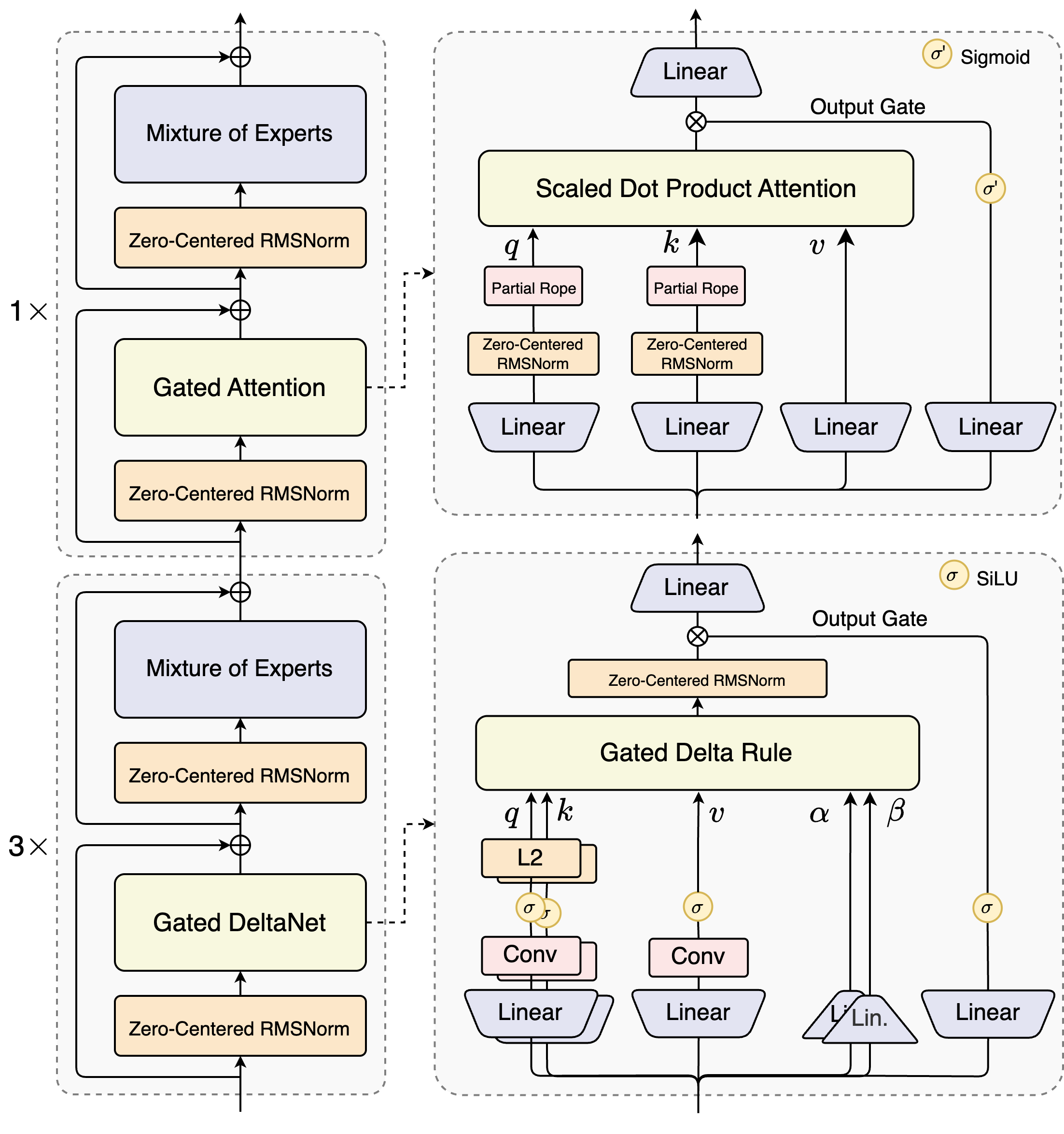
Figure 3: Qwen3 Benchmark Performance
Comparison chart showing Qwen3 performance against other leading models:
Final Thoughts
Qwen3 and its variants represent a paradigm shift in open-source AI, demonstrating that open-weight models can compete with and sometimes surpass proprietary alternatives. The combination of strong benchmarks, permissive licensing, diverse model sizes, and robust ecosystem support makes Qwen3 a compelling choice for researchers, developers, and enterprises alike.
As the AI landscape continues to evolve with models like Qwen3.5 and Qwen3-Next pushing the boundaries of efficiency and performance, the open-source community can look forward to even more accessible and capable models in the future.